
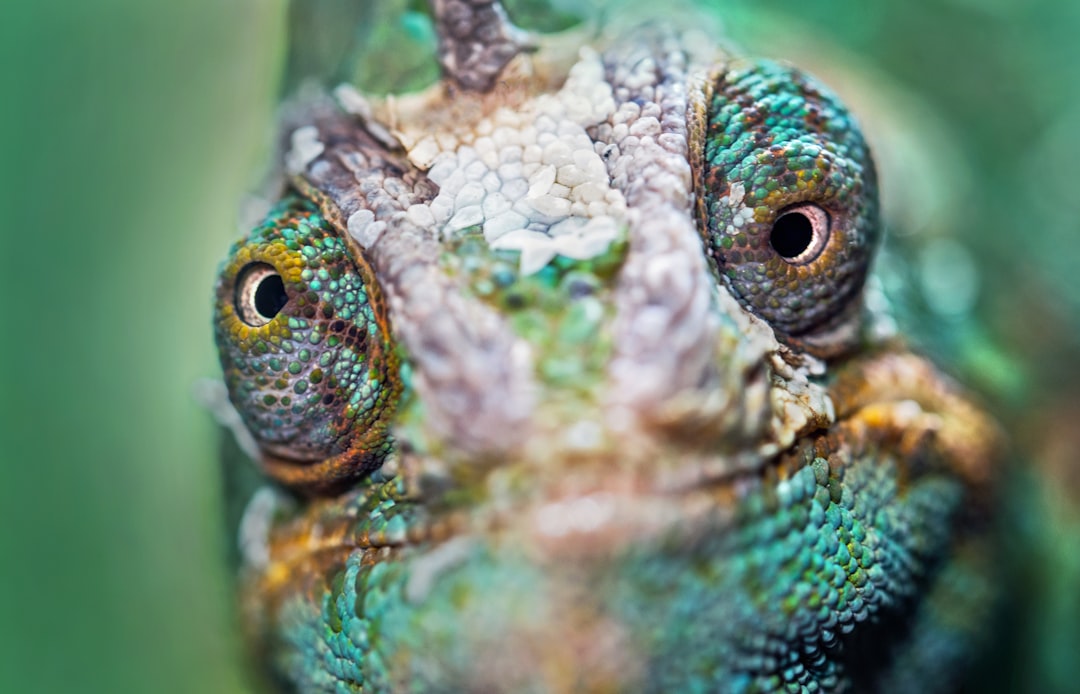
There are many marvels in the colorful world of reptiles, but few animals pique people’s interest more than the chameleon. The Meccha Chameleon is one of these fascinating lizards that stands out for its amazing range of color changes & unmatched skill at camouflage. This amazing reptile, a true marvel of nature, has developed a sophisticated system that enables it to blend in with its environment, convey complicated messages, and even control its body temperature with an accuracy that most other animals cannot match.
The Meccha Chameleon’s remarkable ability to change color is a highly complex biological process based on its distinctive anatomical features rather than just a trick of the light. Its physical characteristics are evidence of millions of years of evolution, with each adaptation helping to ensure its survival & dominance in its native environment. The tiny painters are known as chromatophores. Chromatophores are specialized cells at the center of the Meccha Chameleon’s color-changing spectacle. These cells, which have various pigments, are found in layers beneath the chameleon’s translucent outer skin.
For instance, iridophores are made of reflective nanocrystals that control light to create iridescent greens and blues. In contrast, yellow & red pigments are found in xanthophores & erythrophores, respectively. Melanophores, which are located deep within the skin and contain dark melanin, have the ability to expand or contract, thereby serving as a master switch to change the overall tone of the skin. The Meccha Chameleon is able to produce an incredible range of colors and patterns due to the intricate interaction & regulated expansion and contraction of these different chromatophores, which are impacted by hormonal & neurological signals.
A panoramic surveillance system using independent eye movement. The Meccha Chameleon’s capacity to move its eyes on its own is another amazing adaptation. The chameleon can simultaneously search its surroundings for prey and predators without moving its body thanks to each eye’s 180-degree horizontal & 90-degree vertical swivel. For a creature that depends on ambush predation and must stay motionless to avoid detection, this panoramic surveillance system is essential. This special visual ability also helps with accurate depth perception, which is necessary for hitting prey with accuracy.
The lightning-fast weapon is the projectile tongue. One of the strongest and fastest tongues in the animal kingdom is that of the Meccha Chameleon. Its tongue can stretch up to twice the length of its body in a split second, & it can launch itself with amazing speed and precision to catch unwary insects.
| Category | Metric |
|---|---|
| Release Date | 1982 |
| Artist | Anri |
| Genre | J-pop, City pop |
| Album | Coool |
| Label | For Life Music |
A muscular, sticky pad on the tongue’s tip produces a strong suction that ensures that once prey is caught, it has no chance of escaping. This unique feeding strategy, which enables the chameleon to catch swiftly moving insects with little effort & without sacrificing its camouflage, is a shining example of evolutionary efficiency. Zygodactylous feet and a prehensile tail: Arboreal acrobatics. Being an arboreal animal, the Meccha Chameleon spends the majority of its life in trees. Like a monkey, its prehensile tail serves as a fifth limb, giving it balance & a secure hold on branches.
The chameleon can safely grasp branches thanks to its unusual zygodactylous feet, which have two toes pointing forward and two pointing backward. This allows it to move around its tree-top environment with exceptional stability & agility. Maintaining its precarious perch while pursuing prey or dodging predators depends on these adaptations. The Meccha Chameleon’s ability to change color is a marvel of biological engineering, powered by a complex interaction of cellular mechanisms, biological responses, & environmental cues. Compared to straightforward pigment dispersal, this dynamic process is far more intricate.
Quick Chromatic Adjustment: Immediate Blending in. The Meccha Chameleon’s color change is most remarkable when it happens quickly. The Meccha Chameleon can change its skin pattern and coloration in a matter of seconds, in contrast to some other animals that change color over the course of minutes or even hours.
When a threat materializes or a potential meal needs to be ambushed, this quick chromatic adaptation is essential for instantaneous camouflage, enabling it to blend into a new background with ease. Here, the nervous system is crucial because it provides the chromatophores with instantaneous signals that cause them to quickly expand or contract. Thermoregulation: The internal thermostat of a chameleon. The Meccha Chameleon uses its ability to change color not only for camouflage but also for thermoregulation.
It can regulate how much heat it absorbs or reflects from the sun by varying the lightness or darkness of its skin. Lighter hues reflect sunlight, keeping the chameleon cool in hot weather, while darker hues absorb more sunlight, enabling it to warm up in cooler settings. Maintaining the ideal body temperature requires this advanced internal thermostat, particularly in settings with temperature swings.
A Language in Living Color: Social Signaling. The Meccha Chameleon uses color changes not only for survival but also for social communication. Chameleons communicate with one another in a variety of ways, from submission & courtship to aggression and dominance, using intricate patterns and color displays. While muted or darker colors may indicate stress, submission, or a desire to avoid conflict, bright, vibrant colors frequently represent a healthy, dominant male seeking to attract a mate. Without making direct physical contact, people can communicate and negotiate social hierarchies using the distinct patterns & flashes of color, which can function as a silent but powerful language.
Because of its arboreal nature and specialized hunting methods, the Meccha Chameleon thrives in certain environments. To appreciate its evolutionary adaptations, one must comprehend its natural habitat. A World of Green in Tropical Rainforests. The dense, lush tropical rainforests in its natural habitat are the Meccha Chameleon’s main habitat. These habitats offer a rich tapestry of vegetation, plenty of opportunities for camouflage, and a consistent supply of insect prey.
For the chameleon’s physiological requirements, the rainforest’s high humidity & steady temperatures are ideal. Its prehensile tail and specialized feet make it ideal for negotiating this complex ecosystem’s intricate web of branches and leaves. A lone hunter living in solitude.
Most Meccha Chameleons live alone. Outside of mating season, they seldom interact with other chameleons and prefer to live alone. Living alone lessens the chance of attracting predators & reduces competition for resources. Their remarkable ability to blend in with their surroundings reinforces their desire to live alone.
When interactions do happen, especially between males, they frequently result in intricate and occasionally violent color displays to establish dominance. Ambush predators: accuracy and patience. The Meccha Chameleon, an ambush predator, is the epitome of accuracy & patience.
It remains motionless for long stretches of time, frequently swaying slightly in the breeze to resemble a leaf while it waits for unwary insects to come within striking range. After identifying its prey, it stays still and turns its head slowly and deliberately until it has a perfect aim. Its tongue then lashes out with an explosive burst of speed, quickly securing its meal.
This hunting method is incredibly energy-efficient, and its skill at camouflage complements it perfectly. Like its other biological processes, the Meccha Chameleon’s life cycle is marked by adaptations that guarantee the survival & continuation of its amazing species. A colorful dance of courtship rituals. Meccha Chameleons participate in complex courtship rituals during the mating season. To attract females, males exhibit their most striking & vivid color patterns. To demonstrate their strength and well-being, they may also execute particular body motions and head bobs.
In response, females will use their own color changes to indicate whether they are accepting or rejecting. While a non-receptive female will frequently display dark, aggressive colors to fend off unwanted advances, a receptive female may display softer, more welcoming hues. A safe hatchery for laying eggs.
The female Meccha Chameleon will search for a suitable nesting site after a successful mating, typically excavating a burrow in soft soil or decomposing vegetation. After that, she will lay a clutch of eggs, which, depending on the species and the surroundings, could number anywhere from a few to several dozen. The warmth and humidity of the soil provide the eggs with protection from predators and temperature swings while they are incubating.
Although it frequently lasts for several months, the gestation period can vary greatly. Miniatures of the Masters: Hatchlings. The hatchlings are tiny replicas of their parents when they hatch from their eggs, and they already have the natural capacity to change color, though not as much or as vividly as adults.
They rely solely on their instincts and innate ability to blend in with their surroundings to survive since birth. A chameleon’s early life is dangerous because they are vulnerable to a variety of predators. Only a small percentage will make it to adulthood, so only the strongest and most skilled color-changers will pass on their skills to the following generation.
Like many other species, Meccha Chameleons face many threats to their survival despite their amazing adaptations, chiefly because of human activity. The shrinking green is a sign of habitat loss. Loss and fragmentation of habitat pose the biggest threat to Meccha Chameleon populations.
Their rainforest homes are directly destroyed by deforestation for logging, agriculture, and urban growth, which removes the trees and other vegetation they depend on for hunting, shelter, and reproduction. Populations become isolated as their habitat gets smaller, which lowers genetic diversity and makes them more susceptible to environmental changes. Demand for the Exotic in the Illegal Pet Trade.
In the illicit pet trade, Meccha Chameleons are highly sought after due to their distinctive beauty & intriguing skills. Because individuals are captured & sold on the illicit market, poaching and smuggling operations wipe out wild populations. For these fragile animals, the stress of capture, transportation, and inappropriate captive settings frequently results in high death rates. Public education and stricter enforcement of wildlife protection laws are essential to stopping this harmful trade. A changing world due to climate change.
Meccha Chameleon populations are at long-term risk from climate change. Variations in humidity, rainfall, and temperature can upset their fragile ecosystems, affecting their reproductive cycles, food sources, & general health. Chameleon habitats and populations can also be severely impacted by extreme weather events, such as protracted droughts or powerful storms.
A coordinated worldwide effort to address the underlying causes of climate change and put sustainable conservation strategies into place is necessary to protect these amazing creatures. To sum up, the Meccha Chameleon is proof of the remarkable force of evolution. It is a true master of its surroundings thanks to its complex anatomy, advanced color-changing mechanisms, & unique way of life.
Every part of its body, from its projectile tongue and panoramic vision to its microscopic chromatophores, is carefully crafted for survival and success. But in order to preserve its dwindling habitats and fight the threats that threaten this ultimate color-changing master, humanity must work together. In addition to inspiring wonder, the Meccha Chameleon is a moving reminder of the priceless biodiversity that enriches our world and the pressing need to preserve it.
.
FAQs
What is Meccha Chameleon?
Meccha Chameleon is a Japanese term that translates to “very chameleon” in English. It is often used to describe something that is constantly changing or adapting.
Where is Meccha Chameleon commonly used?
The term Meccha Chameleon is commonly used in Japanese pop culture, particularly in music, fashion, and entertainment industries. It is often associated with the concept of being versatile and adaptable.
What does Meccha Chameleon represent?
Meccha Chameleon represents the idea of being able to blend in or change one’s appearance or style to fit different situations or environments. It can also symbolize the ability to be flexible and versatile in various aspects of life.
How is Meccha Chameleon related to fashion and music?
In fashion, Meccha Chameleon can refer to individuals who have a diverse and ever-changing sense of style. In music, it can describe artists who are known for their ability to experiment with different genres and sounds.
Can Meccha Chameleon be applied to other areas of life?
Yes, the concept of Meccha Chameleon can be applied to various aspects of life, such as career, relationships, and personal development. It encourages adaptability and the willingness to embrace change.












Leave a Reply